Let happiness be…
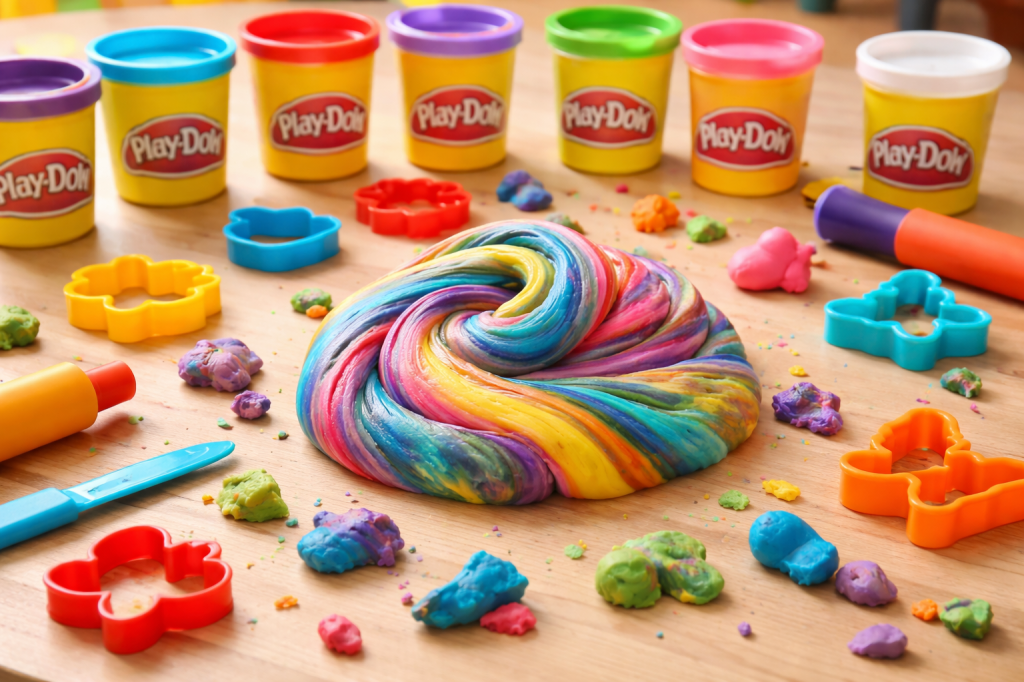
This morning, my four year old son and I sat at the table in his play room with his Play-Doh. A Christmas present. Still new. Still vivid. Each colour sealed inside its own small, colour coordinated tub. Reds with reds. Blues with blues. Everything neatly contained, largely untouched (this wasnt the first time we had played with the set since Christmas), full of future potential. There was something deeply satisfying about the order of it all. The uniform lids. The tidy rows. The promise that everything would remain exactly as it was, at least for a while. The way I like things…
He began mixing them.
At first, it was almost tentative. A streak of blue folded into yellow. Red pressed into green. The combinations he created were oddly beautiful. Swirls and marbling that no adult would ever think to design. Colours layered and twisted together in ways that felt both deliberate and entirely accidental.
There was no theory behind it, no plan, no attempt to optimise the result. No concern for the end state. Just instinct, curiosity, and play. The kind of attention that exists only when time is irrelevant and outcomes do not matter.
I, meanwhile, became cautious.
I started to limit how much he could mix. I found myself intervening, suggesting moderation, quietly redirecting his hands back towards separation rather than combination. I felt a low level anxiety about waste. About how quickly the Play-Doh would lose its freshness, how soon those bright colours would be gone forever. Once mixed, they could never be returned to their original state.
I was trying to preserve value, even if I could not quite articulate what that value was or who it was really for.
He carried on regardless.
Eventually, I asked him why he wanted to mix all the different colours together. It was a genuine question, but also, if I am honest, a subtle attempt to introduce reason into something that did not need it.
He looked up at me and said, without hesitation, “Because it makes me feel happy, Daddy.”
Something changed in me at that moment.
The answer was so simple, so complete, that there was nothing left to argue with. All the rules dissolved. All the internal calculations stopped. The quiet voice in my head that worried about longevity and prudence fell silent.
From that point on, he was allowed to mix everything. As much as he liked. He blended the entire collection into one large lump of indeterminate brown. To him, it looked exactly like a giant poo, which he found utterly hilarious. His laughter filled the room, unfiltered and unrestrained.
Mine followed shortly after.
That small exchange stayed with me long after the Play-Doh was packed away. It made me think about happiness, and how rarely we allow it to be a meaningful measure of our wellbeing in any given moment. How often we subordinate it to efficiency, prudence, or longevity. How quickly we override it with adult logic about what should last, what should be saved, what should be sensible.
We are very good at explaining happiness away. At postponing it. At treating it as something to be earned later, once the sensible decisions have been made and the resources carefully preserved.
Happiness, I realise, does not work like that.
It is immediate. It exists only in the present tense. It does not justify itself. It does not explain itself. It simply appears and asks whether we are willing to allow it space, even when it feels inconvenient or inefficient.
It is also infectious. His happiness softened me instantly. It loosened something tight and unnecessary. It reminded me of a way of being I once knew instinctively and now plan to relearn. A way of engaging with the world that prioritises experience over preservation, presence over planning.
As a child, he should pursue what makes him happy. Not endlessly, not blindly, but honestly. He should listen to the small internal signals that tell him something matters, something delights him, something feels right. Those signals are fragile, and they are easily drowned out by adult caution.
And as his parent, I should not stand in the way of that.
Not because happiness is the only thing that matters, but because it is often the clearest indicator that we are aligned with ourselves. That, for that moment at least, we are exactly where we are supposed to be.
A table. A child. A mess of colours. A lump of brown Play-Doh. And a quiet reminder that happiness does not need to be preserved.
It needs to be allowed.
Thanks for reading, and Happy New Year all.
 Law Work Culture & More
Leave a comment